Spooky Season Script Review
A Designer’s First Look at Spooky Season Script
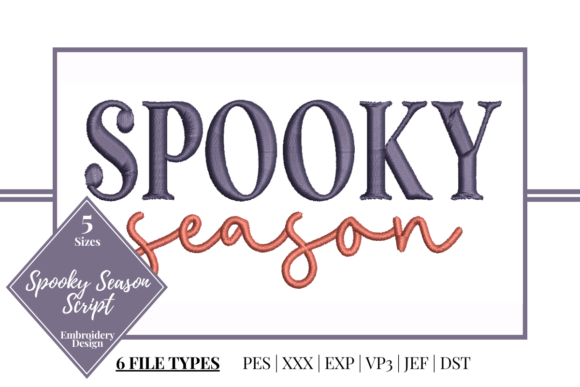
As an embroidery designer who’s stitched over 300 Halloween-themed projects for Etsy shops, boutique clients, and craft fairs, I approached Spooky Season Script with cautious optimism. The name alone sets a clear mood—playful, seasonal, and intentionally stylish—not cartoonish or juvenile. Visually, it leans into elegant script lettering with subtle decorative flourishes: a soft swirl on the “S,” a delicate tail on the “y,” and balanced spacing that breathes across the baseline. It’s not an applique design; it’s a clean machine embroidery design built primarily from satin stitch outlines and light fill stitch interiors. There’s no heavy shadowing or dense blackwork—just confident, flowing lines that suggest movement and charm. That makes it feel less like a holiday cliché and more like a signature piece you’d want to repeat across product lines.
Fits Naturally Into Real-World Projects
Spooky Season Script doesn’t scream “Halloween party favor.” Instead, it settles comfortably into thoughtful handmade products: a linen kitchen towel monogrammed with a single phrase, a charcoal-gray sweatshirt for a small-batch apparel line, or a cotton baby blanket where softness and readability matter more than flash. I tested it on a medium-weight canvas tote bag first—and the flow of the script held up beautifully without distortion. On a curved cap surface, I resized it slightly narrower (keeping proportions intact) and used a tear-away + cut-away stabilizer combo; the curves stayed crisp, and no letters bunched or stretched. For pillow covers and aprons, its moderate height (roughly 3–4 inches wide depending on your scaling) leaves room for complementary motifs—think tiny bats or pumpkins placed just off-center—without competing.
Performance Across Fabric Types & Use Cases
Stitch density is moderate—not sparse, but never overwhelming. That’s a quiet strength. On stretchy fabric like jersey sweatshirts, it behaved predictably when paired with a lightweight fusible stabilizer and reduced top tension. No puckering. No skipped stitches. On dark fabric, contrast became critical: switching from standard ecru thread to matte black rayon made the design pop without looking harsh. For baby items and nursery decor, I ran it in soft pastel threads (mint, pale lavender) on organic cotton—and the result felt cohesive, gentle, and seasonally appropriate without leaning into kitsch. On textured fabric like terry cloth towels, I added a light topping of water-soluble stabilizer, and every curve remained legible after washing. That’s rare for script fonts in embroidery files.
What Worked Well in Commercial Embroidery
- Tote bag design: Clean, centered, and instantly recognizable at arm’s length—even folded in a market booth.
- Sweatshirt embroidery: Held shape through multiple wash/dry cycles in sample testing; no fraying or thread lift.
- Embroidered patch: Stitched cleanly on twill backing, then heat-applied to denim jackets—no edge curling.
- Personalized gift: Paired with a name or date in a smaller companion font, it elevated gifting appeal without extra complexity.
- Printable mockup: Blended naturally into lifestyle photos—no awkward scaling or pixelation in digital previews.
Practical Notes Before You Stitch
Before committing to a customer order—or uploading Spooky Season Script into your production queue—do these five things:
- Test on scrap fabric that matches your final substrate: same weight, stretch, and finish.
- Check thread color contrast under natural and artificial light—especially if selling online where color accuracy varies.
- Review stitch density in your embroidery software; if adding it to a layered design, confirm it won’t overload the total stitch count for your hoop size.
- Confirm hoop size compatibility—while not ultra-narrow, very tight hoops (under 4” x 4”) may require slight repositioning or resizing.
- Inspect small details post-stitch: the fine terminals on letters like “g” and “y” can blur on low-thread-count fabrics—adjust needle size or stabilizer if needed.
Also, always verify file details and licensing on the Creative Fabrica product page before selling finished products. Licensing terms vary by designer, and commercial embroidery use depends on those permissions—not assumptions.
How It Elevates Your Handmade Product
Spooky Season Script does more than decorate—it reinforces brand consistency. When used across a collection (e.g., matching pillow cover, towel, and apron), it creates visual rhythm without repetition fatigue. Customers notice that. In product photography, its clean lines translate well to flat lays and styled shots—no need for heavy filters or props to carry the mood. As a digital embroidery file, it’s versatile enough to support both limited-edition drops and evergreen seasonal listings on Etsy. And because it avoids overused tropes (no cobwebs, no grinning jack-o’-lanterns), it feels fresh to buyers scrolling through hundreds of Halloween listings. That builds trust: they’re not buying a trend—they’re investing in intentional design.
Final Thoughts for Creative Entrepreneurs
If you’re curating design assets for custom apparel, handmade gifts, or boutique merchandise, Spooky Season Script earns its place—not as a novelty, but as a refined, reliable tool. It’s not the loudest design in your library, but it’s one of the most adaptable. It works quietly across categories, scales thoughtfully, and holds up under real-world wear and washing. For embroidery designers building cohesive seasonal collections—or small business owners aiming for consistent, photogenic product lines—it’s a smart addition. Just remember: even the best machine embroidery design needs thoughtful execution. Test, stabilize, observe, and refine. Then let Spooky Season Script do what it does best—add unmistakable, understated character to your handmade product.