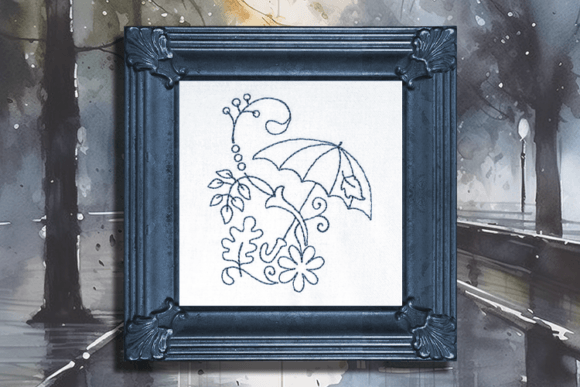
Autumn’s Rainy Day Umbrella
A Line Art Embroidery Design That Feels Like a Quiet October Morning
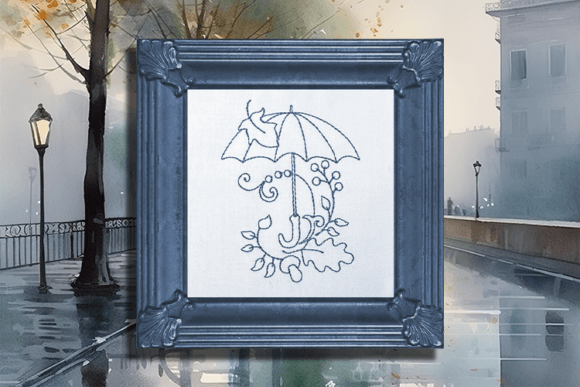
As an embroidery designer who’s stitched hundreds of seasonal motifs for Etsy shops, boutique apparel lines, and custom gift clients, I approached Autumn’s Rainy Day Umbrella with quiet curiosity—not hype. It’s not flashy. There are no glitter effects, no layered appliqué, no dense fill stitches mimicking foliage. Instead, it’s a line art embroidery design built on rhythm, restraint, and resonance. The umbrella’s gentle curve, the subtle suggestion of falling raindrops, and the open space around the composition evoke that hushed, golden-hour calm when autumn air feels crisp and time slows just enough to notice the details.
What This Design Naturally Wants to Be Stitched On
Autumn’s Rainy Day Umbrella doesn’t shout—it invites. Its clean lines and intentional negative space make it ideal for projects where subtlety elevates handmade value: minimalist tote bags, unbleached cotton aprons, oatmeal-toned baby blankets, linen pillow covers, and lightweight kitchen towels. I tested it first on a medium-weight organic cotton sweatshirt—and the result was unexpectedly tender. No visual competition with fabric texture; just quiet confidence in the stitchwork. It also translates beautifully into embroidered patches (heat-applied or sewn-on), especially when backed with lightweight fusible webbing for stability without stiffness.
Real-World Performance Across Common Projects
On curved surfaces like caps, the simplicity of Autumn’s Rainy Day Umbrella becomes a strength—not a limitation. With no tiny interior details or overlapping elements, it hoops cleanly in standard 4×4 hoops and maintains clarity even when digitized for smaller 3.5×3.5” applications. For stretchy fabrics like jersey or ribbed knit sweatshirts, I paired it with a light cutaway stabilizer (hoop-and-stitch method) and saw zero distortion in the umbrella’s arc or raindrop spacing.
Dark fabric? Yes—especially with high-contrast thread colors like charcoal gray or deep burgundy against navy or black denim. Because it’s line art, there’s no risk of fill stitch bleeding or density-related puckering. On light fabrics, soft ecru or oat thread keeps the mood serene; for gift-ready presentation, a single-tone variegated thread adds gentle dimension without complexity.
For baby items and nursery decor, its gentle shape and absence of sharp angles or intricate internal geometry mean fewer snag points and easier care. After three gentle machine washes on a test baby blanket, the stitching held crisp edges—no fraying or loosening—thanks to balanced stitch density and consistent running stitch flow.
How It Shapes Your Handmade Product’s Story
In my experience, buyers don’t just purchase embroidery—they buy intention. Autumn’s Rainy Day Umbrella communicates thoughtfulness: the kind that says “I chose this because it fits the season, the recipient, and the moment.” That translates directly to perceived value. On Etsy listings, it pairs seamlessly with printable mockups showing the design on a folded linen towel or a relaxed-fit crewneck—clean visuals that support brand consistency without overwhelming the product photo.
For craft fairs or local boutiques, it helps differentiate your booth. While others lean into bold pumpkins or scripty “Fall Y’all” phrases, this design offers quiet sophistication—a signature touch for customers who appreciate understated seasonal charm. And because it’s not tied to a specific holiday or trend, it stays relevant across multiple autumn months and even into early winter gifting.
Practical Notes Before You Stitch
- Always test on scrap fabric—especially if pairing with textured weaves (like waffle-knit towels) or loosely spun yarns (such as some hand-dyed cottons). Line art can disappear into heavy texture if thread tension isn’t dialed in.
- Review stitch density before finalizing. Though described as clean-line, check the actual file’s stitch count and pathing. Some line art designs over-travel or add unnecessary jump stitches—these affect thread consumption and machine noise.
- Confirm hoop size compatibility with your most-used machines. If you rely heavily on compact hoops (e.g., 3×3”), verify whether the design scales down without losing legibility—particularly the fine raindrop lines.
- Compare light and dark fabric mockups digitally before stitching. A design this delicate can look dramatically different depending on contrast, and that affects buyer expectations.
- Use appropriate stabilizer: tear-away for stable wovens (totes, towels), light cutaway for knits (sweatshirts, caps), and water-soluble topper for napped fabrics (terry cloth, fleece).
- Inspect small details post-stitch, especially where the umbrella handle meets the canopy curve. Clean line art should read as one fluid motion—not segmented or misaligned.
- Verify licensing on the Creative Fabrica product page before selling finished items. As a commercial embroidery user, I always double-check permitted use—especially for digital embroidery files intended for resale products.
Final Thoughts for Designers and Small Business Owners
Autumn’s Rainy Day Umbrella won’t replace your go-to floral bouquet or monogram set—but it fills a distinct niche: the thoughtful, seasonally grounded accent that makes a handmade product feel curated, not cluttered. It works equally well as a standalone motif or part of a coordinated collection (pair it with simple leaf silhouettes or a single acorn for subtle variety). For Etsy sellers building cohesive autumn-themed listings, it’s a reliable anchor design—versatile enough for apparel, home goods, and personalized gifts, yet distinctive enough to stand apart.
If your workflow values clarity over complication—if your customers respond to craftsmanship that breathes rather than shouts—then this Creative Fabrica embroidery design earns its place in your active design assets. Not as a novelty, but as a quietly capable tool: ready for real projects, respectful of fabric and thread, and true to the season it represents.